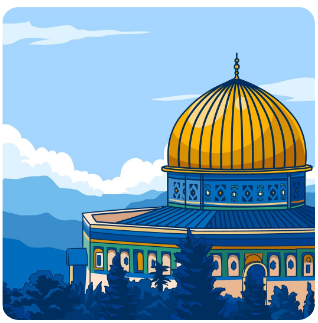
Al-Aqsa Mosque
The Al-Aqsa Mosque was built in the Holy Sanctuary, and it is also ancient. The origin of the Al-Aqsa Mosque is a church built by Emperor Justinian in veneration of the Virgin Mary. The Arabs converted it into a mosque by order of Caliph Omar. Then the earthquake destroyed the Al-Aqsa Mosque, and it was rebuilt in the year 785 AD. Then the hand of reform reached it and gave it an Arab touch over time, at least in the details. Then Saladin restored it in the year (583 AH / 1187 AD) , and then in the fifteenth century AD, some of its parts were renewed, such as its portico.
The Al-Aqsa Mosque includes columns taken from many buildings, and we believe that its central courtyards, which are in the Byzantine style, were built in the seventh century.
The arches of the Al-Aqsa Mosque are generally made according to the design of the Picarinians. The Crusaders inhabited the Al-Aqsa Mosque and used its vestibule as a storehouse for the weapons of the Knights Templar.
The Al-Aqsa Mosque contains an elegant mihrab decorated with mosaics, and its inscription indicates that it was built by Saladin in the year (583 AH/1187 AD) . Its amazing minbar, made of carved wood inlaid with ivory and shells, was erected in the year (564 AH/1168 AD). The glass of its windows above its mihrab dates back to the sixteenth century AD.
On the two sides of the Al-Aqsa Mosque, there are two ways of praying; one of them has twisted columns and arches made in the style of the locusts, and it is called the Mihrab of Omar on the claim that Omar prayed in it, and the other is called the Mihrab of Zechariah, usually.
Other Arab buildings in Jerusalem:
Other Arab buildings in Jerusalem are less important than what we have mentioned above, and we will suffice with mentioning among them: the beautiful Damascus Gate, which Sultan Suleiman rebuilt, or if you prefer, restored, in the year (944 – 1537 AD) .
If we exclude the few other historical buildings, such as the Church of the Holy Sepulchre, we see nothing in Jerusalem but modern buildings. European influence in Jerusalem has a clear effect leading to the gradual removal of its oriental character. When one approaches Jerusalem via Jaffa, one feels the dissipation of one’s dreams, as one sees monasteries, hospitals, and many consulates and thinks one is in a suburb of a large city.
Whoever wishes to witness the greatness and majesty of Jerusalem should ascend the Mount of Olives in particular, and then look back to see Jerusalem full of domes, minarets, walls, towers with balconies, and houses with courtyards.
And the memories in Jerusalem are enough on their own to make it a place of glorification, and to attract pilgrims to it from the farthest corners of the earth. And how magical and wonderful those memories are in the hearts of the believers who visit the Holy Sepulchre, the Mount of Olives, the Kidron Valley, the Jehoshaphat Valley, the Tomb of the Virgin, the Tomb of the Kings of Judah, the Holy Way, Mount Zion… and so on, from the places that abound in the vicinity!
No matter how atheistic one may be, one cannot be indifferent to Jerusalem, the birthplace of one of the great religions. It is as if the shadow of Christ still looms over Jerusalem, the place of his death, and his name still echoes there. It is not permissible to delve deeply into the matter of these holy places, for this would diminish their influence. It is the imagination dictated by firm faith that points to them, even though their physical traces have been lost for a long time. Is that garden the Garden of Olives where Christ lamented his fate? Is that road the road Christ walked to be crucified? Is that tomb that Christians venerate the tomb that held Christ’s body after his death?
Modern archaeology is very strict in its answers to these questions. It says that the present Jerusalem stands, a few meters away, on the ruins of the past Jerusalem that Titus ordered to be destroyed, so it is impossible to draw its ancient plans. But faith alone is enough for the believer, and no wonder, for man does not sanctify anything but imaginings, and the ancient ones are the most honored because they are the most honored.
The Arab Ramla Tower:
I mention the Ramla Tower as one of the few ancient Arab buildings in Syria. This tower is located near the small city of Ramla, situated between Jerusalem and Jaffa.
The Arabs call the Ramla Tower the Tower of the Forty Martyrs, and they assert that forty Muslim martyrs were buried there.
The Ramla Tower is a beautiful example of Arab architecture. It is square in shape, and light enters it from windows made in the style of the Picarine. Its summit is topped by a staircase consisting of ? ? ? steps, which are still in good condition except for the last steps.
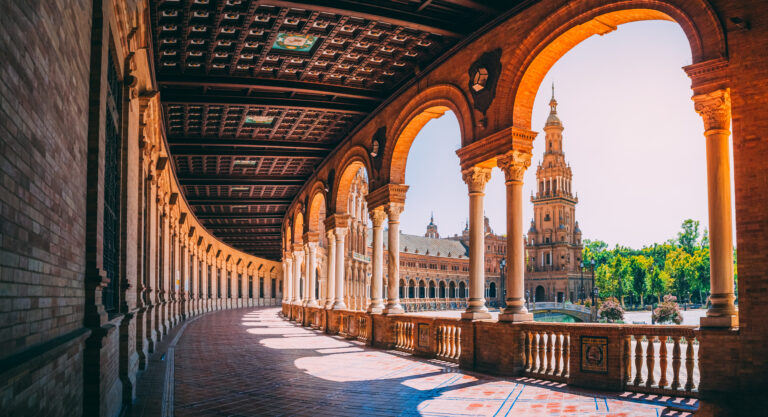
Figure 1-10: The ceiling of the first inner portico in the Omar Mosque (from a photograph taken by the author) .
Some have called the Ramla Tower a Crusader monument, and it reminds us of the style that the Crusaders brought to Europe in reality, but there should be no doubt about its Arab origin, which is established by its details and the art of its construction, and by the inscription that indicates that it was built in the year (700 AH/1310 AD) , which matches what one of the Arab historians narrated that the son of Sultan Qalawun was the one who built it, and the condition of the stone on which that inscription is engraved negates any possibility of this stone being added recently to the Ramla Tower.